Lower peak wall temperature and longer kettle life.
SHIVAS Technology · Galvanizing
High-velocity burner
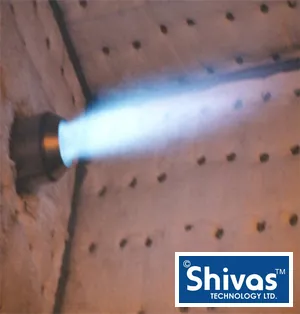
High-velocity burners that drive hot gas along the kettle wall instead of blasting one spot.
- Start: Air proof · purge · spark · prove
- Ignition: Direct spark, no pilot
- Proving: UV scanner
- Firing: Pulse high / low
 1 photo
High exit velocitystirs furnace gas for even heat
Pulse firinghigh / low cycling for control
UV-proved ignitionflame supervised at all times
Overview
A high-velocity burner completes combustion in its own refractory chamber and leaves the nozzle as a fast jet of hot gas. The jet entrains furnace gas and keeps it moving round the kettle, so heat reaches the wall by convection over a large area instead of radiating from a flame onto one patch of steel.
SHIVAS engineers the combustion system around the kettle: number and position of burners, firing pattern, air and gas trains, ignition and flame supervision, and the control logic that pulses the burners between high and low fire to hold temperature.
Why it pays
Pulse firing holds the bath within a few degrees.
Gas train with double shut-off, proving and UV flame supervision.
Gas, LPG or oil versions.
Technical specification
Typical ranges. Every unit is sized to your duty; the offer carries the exact figures.
| Type | High-velocity, nozzle-mixing |
|---|---|
| Control | Pulse high / low or modulating |
| Ignition | Direct spark, UV flame supervision |
| Fuel | NG, LPG; oil on request |
| Air | Combustion air blower with pressure switch |
| Mounting | Through the furnace wall, firing along the kettle |
Calculator
Work it out for your own plant. Every input is a typical value you can change and the results follow as you type; send the result to us and we reply with a proposal.
How it works
High-velocity burner
Watch it run →Inside one burner: gas through the central lance, combustion air through the swirler, a refractory chamber where the flame forms and a nozzle that throws hot gas out at high velocity. The burner control unit proves air, purges, then lights the main gas directly with a spark. No pilot.
Main parts
- 1Gas lanceCarries fuel gas to the burner head.
- 2Air plenumCombustion air from the furnace blower.
- 3SwirlerSpins the air so it mixes fast with the gas.
- 4Combustion chamberRefractory tube where the flame burns.
- 5Exit nozzleNarrows the outlet so the gas leaves fast.
- 6Ignition electrodeDirect spark ignition: lights the main gas at low fire. No pilot burner.
- 7UV flame scannerProves the flame inside the safety time. No flame, no gas.
- 8High-velocity jetDrives the circulation round the kettle.
- 9Burner control unitRuns every start in the same order; locks out on any fault.
- 10Air pressure switchProves combustion air before purge and ignition.
- 11Ratio controllerMeters gas to match the air pressure across the range.
At a glance
- Start
- Air proof · purge · spark · prove
- Ignition
- Direct spark, no pilot
- Proving
- UV scanner
- Firing
- Pulse high / low
Options, build and uses
Options
- Recuperative air preheat
- Dual fuel
- Burner management PLC panel
How we build it
- Burners from established makers
- Placement, gas trains and control logic engineered by SHIVAS
Who it is for
- Galvanizing furnaces
- Dryers and preheat ovens
- Furnace retrofits
Part of
3D model
Computer model from a real SHIVAS project. It shows the arrangement; it is not a photo.
Questions buyers ask
Why high velocity rather than flat flame?
The fast jet circulates furnace gas so the whole wall is heated; flat flames tend to heat the wall nearest the burner.
Can you retrofit our furnace?
Often, yes. We check casing, lining and burner positions first.
From our engineers
Practical notes from the engineers who design and build these plants.
Enquiry · High-velocity burner
Get a quote
Tell us the capacity, sizes and site. We reply with a scheme, a layout and an offer.
What we need for your quote
- Kettle and furnace size
- Fuel and supply pressure
- Existing burner make if retrofitting