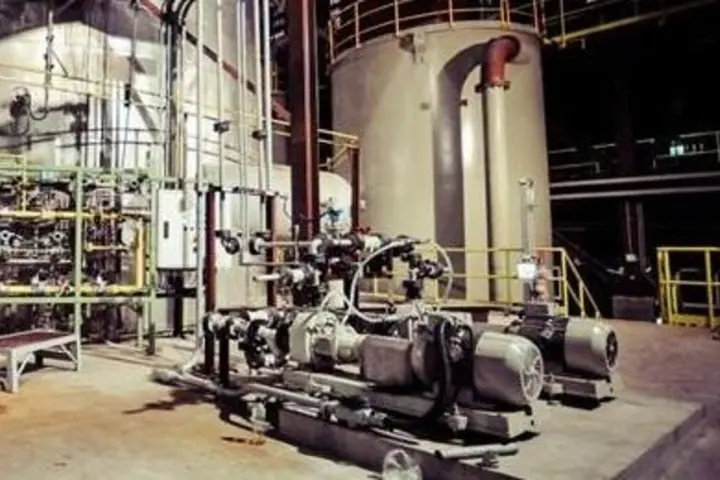
ZLD for pickling and galvanizing effluent: designing the whole plant
From acidic rinse water to dry salt: stream segregation, neutralisation, filter press, RO, evaporator and ATFD, with a worked balance for a 90 m³ a day plant.
Zero liquid discharge means that no effluent leaves the site as a liquid. Every cubic metre of water is either recovered for reuse or evaporated, and everything that was dissolved in it leaves as a solid: filter cake and dry salt. For a pickling or galvanizing shop that is a chain of plants, each doing one job. The cost of the whole chain is set by two numbers: how much water reaches it, and how much salt that water carries.
Know your streams
| Stream | Typical character | Best route |
|---|---|---|
| Rinse water after pickling | Large flow, weak acid, some iron | ETP, then RO and the evaporator |
| Spent pickling acid | Small flow, little free acid, a lot of iron chloride | Regeneration or recovery where possible; otherwise the ETP |
| Scrubber bleed | Small flow, weak hydrochloric acid | ETP |
| Degreasing dumps | Occasional, alkaline, oily | Oil removal, then the ETP, dosed in slowly |
| Flux | Should not be a stream at all | Regenerate it instead of dumping it |
Keep the streams apart until each reaches the plant built for it, and keep the spent acid out of the ETP if you can. It is the smallest stream, but it carries most of the iron and the chloride, and so most of the salt the ZLD plant will have to dry.
The chain, step by step
- Equalisation. A tank that evens out flow and strength, so everything after it sees a steady feed.
- Neutralisation and oxidation. Lime or caustic soda raises the pH to about 9, and air turns dissolved ferrous iron into ferric hydroxide, which settles well.
- Clarifier and filter press. The hydroxide sludge settles out and is pressed into cake.
- Filters. Sand and carbon or cartridge filters polish the clear water. The iron must be kept very low here, because iron fouls RO membranes.
- Reverse osmosis. Most of the water comes back clean. The reject carries nearly all the salt in a much smaller volume.
- Evaporator. A multiple-effect evaporator (MEE), driven by steam, or a mechanical vapour recompression evaporator (MVR), driven by electricity, boils most of the remaining water off as condensate for reuse.
- Crystallizer, where it pays. Sodium chloride can be crystallized and centrifuged out of the concentrate.
- ATFD. An agitated thin film dryer turns the last concentrated brine into dry powder.
A worked example
Take 88 m³ a day of rinse water and scrubber bleed carrying 1.5 g/L of acid as HCl and 0.8 g/L of iron, plus 2 m³ a day of spent acid with 130 g/L of iron. That is 90 m³ a day, the size of the plant in our ETP and ZLD 3D model. Neutralised with lime, this is the balance the SHIVAS calculator gives with typical values:
| Stage | Result |
|---|---|
| Acid load | 207 kg of HCl and 330 kg of iron a day |
| Hydrated lime | 793 kg a day |
| Filter cake at 35 % solids | 2.2 t a day |
| Salt in the treated water | 1,104 kg a day, about 11,500 mg/L, mainly calcium chloride |
| RO at 75 % recovery | 71.8 m³ a day of water back; 23.9 m³ a day of reject at about 45,000 mg/L |
| Evaporator | 22 m³ a day of water evaporated |
| with a 4-effect MEE | 6.9 t of steam a day |
| or with an MVR | about 660 kWh a day |
| ATFD | 1.6 m³ a day evaporated with 1.9 t of steam, leaving 1.13 t of dry salt |
| Water recovered | about 98 per cent |
Two things stand out. The spent acid is only 2 of the 90 cubic metres, but it brings 260 of the 330 kg of iron and most of the salt. And RO, the cheapest way to recover water, does three quarters of the work, so the evaporator sees only a quarter of the flow.
The choices that decide the cost
- How much spent acid goes to the ETP. Regenerating or recovering it takes most of the salt out of the problem. See what to do with spent pickling acid.
- Lime or caustic soda. Lime is cheaper and gives calcium chloride, which stays dissolved to very high strength and dries to a powder that draws moisture. Caustic soda gives sodium chloride, which crystallizes. See lime or caustic soda.
- How far RO can go. Every point of recovery takes water off the evaporator. See RO before the evaporator.
- MEE or MVR. Steam against electricity, capital cost against running cost. See MEE or MVR.
- Where the ATFD comes in. See where the ATFD fits.
- Less water in the first place. Counterflow rinsing can cut rinse water many times over. See counterflow rinsing.
Materials
Hot chloride brines are among the most corrosive liquids in any plant, and hot, concentrated calcium chloride can even release hydrochloric acid. Evaporator and dryer parts that touch hot brine are made in materials chosen for it, such as duplex or super duplex stainless steel, or titanium where the conditions demand. Tanks, ducts and pipes at lower temperatures can be PP, PP-H or FRP.