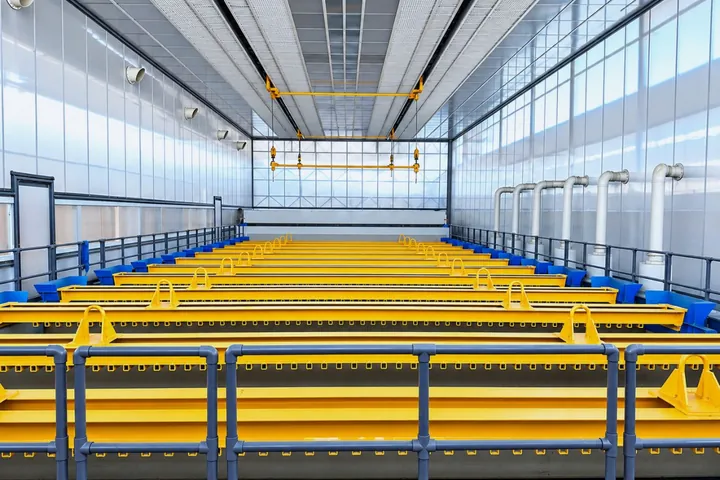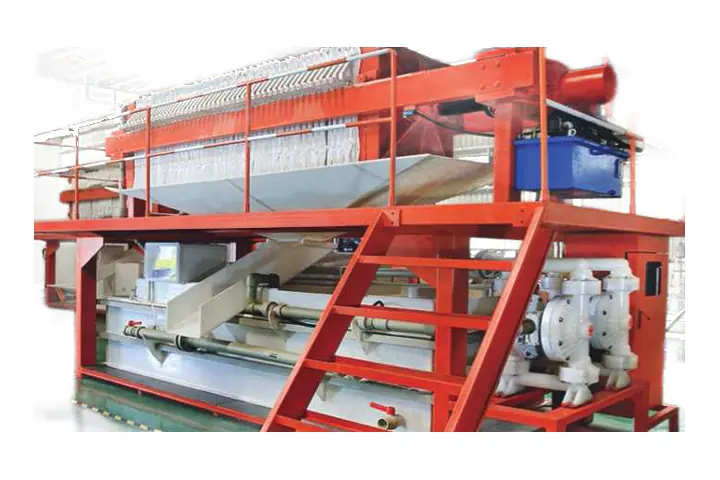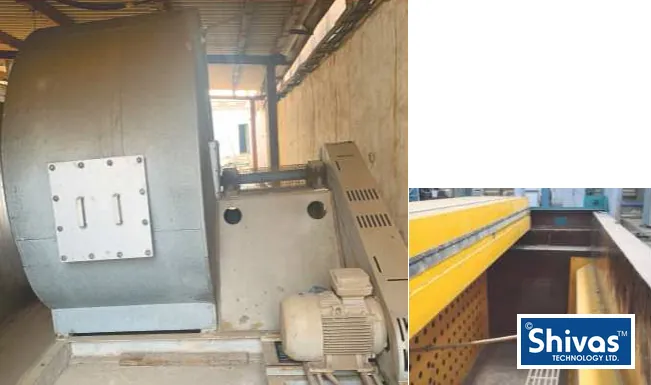
PP-H and FRP do not corrode in acid; heavy wall sections and bracing take crane knocks.
SHIVAS Technology · Galvanizing
Pretreatment tanks
Degreasing, pickling, rinse, flux and passivation tanks in PP-H, FRP and mild steel, made in our shops and built on the robust side.
- PP-H, FRP, MS
- In-house fabrication
- Heated tanks
- Heavy wall sections
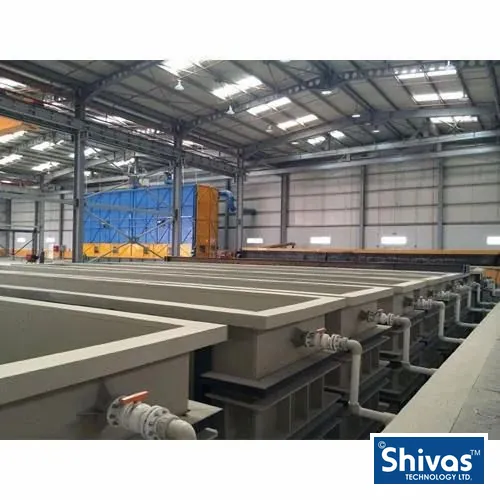 2 photos
PP-H · FRP · MSmaterials chosen per bath
Built in-housetanks and bracing from our shops
Heated where it paysdegreasing and flux at temperature
Overview
Clean steel is the start of a good coating. Pretreatment removes oil, scale and rust and leaves a thin flux film that lets zinc react evenly. Poor pretreatment shows up later as bare spots, rough coatings, extra dross and zinc consumption.
SHIVAS designs the line from your dip cycle: the number of pickling tanks follows from pickling time, tanks are sized round the kettle, and each bath gets the right material. PP-H tanks are thermoplastic-welded with steel or FRP bracing; heated baths get heat exchangers; lip extraction is built into the rim where fume is expected.
Why it pays
Pickling time and dip cycle set the tank count, so the kettle never waits.
Correct concentration, iron control and rinsing extend acid life.
Lip slots and covers designed into the tanks.
Technical specification
Typical ranges. Every unit is sized to your duty; the offer carries the exact figures.
| Baths | Degreasing, pickling (HCl), rinse, flux, passivation |
|---|---|
| Materials | PP-H, PP, FRP, PP-FRP, MS lined |
| Bracing | Steel or FRP |
| Heating | PP or PVDF coils, plate heat exchangers, flue heat |
| Size | Inside about kettle length + 0.3 to 0.5 m |
| Extraction | Lip, double lip or push-pull |
Calculator
Work it out for your own plant. Every input is a typical value you can change and the results follow as you type; send the result to us and we reply with a proposal.
How it works
Flux tank heating
Watch it run →Flux works best warm. Galvanized work brings about 450 °C of heat into the quench tank on every dip; a pump sends that hot quench water through a coil in the flux tank and back, and a 3-way valve driven by the flux sensor holds the set point. The flux is warmed and the quench is cooled, with no fuel burnt.
Main parts
- 1Quench tankHot galvanized work is quenched here; its heat warms the water.
- 2Circulation pumpDraws hot water from the quench tank.
- 33-way valveSends water through the coil, or straight back when the flux is warm enough.
- 4Heating coilPP / PVDF coil inside the flux.
- 5Sensor + PIDMeasures flux temperature and positions the valve.
- 6Flux tankPP-H tank, fabricated in our shop.
- 7Return to quenchCooled water goes back, so the quench runs cooler too.
At a glance
- Set point
- ≈ 55 °C (50–60)
- Heat
- Recovered from the quench
- Control
- PID + 3-way valve
- Tank
- PP-H
Options, build and uses
Options
- Acid enclosed room
- Flux regeneration
- Acid recovery and regeneration
- Tank covers
How we build it
- Thermoplastic welding to DVS practice
- Leak tested before dispatch
Who it is for
- Galvanizing plants
- Pickling shops
- Plating and surface treatment
Part of
3D model
Computer model from a real SHIVAS project. It shows the arrangement; it is not a photo.
From our engineers
Questions buyers ask
How many pickling tanks do we need?
Pickling time divided by the dip cycle, plus a spare for acid changes. The calculator gives a first number.
PP-H or FRP?
PP-H for most acid baths at moderate temperature; FRP or PP-FRP for large sizes and higher temperatures.
Enquiry · Pretreatment tanks
Get a quote
Tell us the capacity, sizes and site. We reply with a scheme, a layout and an offer.
What we need for your quote
- Kettle size or largest article
- Dip cycle and tonnage
- Bath temperatures
- Steel condition (scale, rust, oil)