Preparing wire rod for drawing: descaling, coating and pointing
Half of what happens in the die is decided before the rod gets there. How to descale, coat, point and join rod so the line draws fast and the dies last.
Hot-rolled rod arrives covered in mill scale: a hard, brittle skin of iron oxide. Carried into a drawing die, scale acts like grinding paste. It scores the die, scratches the wire and breaks the lubricant film, and every die after it pays for it. Good drawing starts with a clean, coated, well-presented rod.
Mechanical descaling
Bending the rod back and forth over a set of rollers cracks the brittle scale off the ductile steel underneath. Brushes, abrasive belts or shot then take off what is left. It runs inline at drawing speed, uses no acid and makes no effluent, which is why most low carbon wire is descaled this way.
- Set the bending rollers for the rod size. Too little bending leaves scale; too much work-hardens the surface.
- Change brushes and abrasive before they glaze. A worn brush polishes the scale instead of removing it.
- Collect the scale. Loose scale on the floor and in the soap boxes ends up in the dies.
When to pickle instead
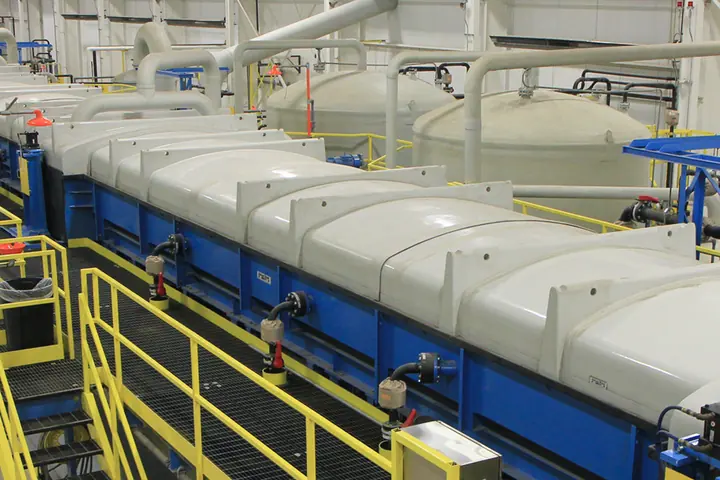
Mechanical descaling always leaves a little scale. For high carbon and spring wire, wire for fine sizes, and wire that will be galvanized or coated later, most plants pickle the rod in acid instead, then rinse it, put on a carrier coating and dry it. Pickling high carbon rod lets some hydrogen into the steel, so give pickled coils time, or a low-temperature bake, before drawing them hard. Fumeless pickling keeps the acid and its fume inside covered tanks.
The carrier coating
Dry drawing soap only works if the rod carries it into the die. Lime, borax or phosphate, dried onto the clean rod, gives the soap something to hold on to. An even coat and a dry coil matter more than the exact recipe: a damp coil cakes the soap, and a patchy coat starves the first die. A coil dryer after coating makes the result consistent, whatever the weather.
Pointing and joining
Every coil has to be threaded through the dies. A pointing machine rolls or swages the rod end down so it passes the first die without forcing. Then, to run without stopping at every coil, the tail of one coil is butt-welded to the head of the next.
- Anneal every weld before it is drawn. A hard weld breaks in the die.
- Trim the weld flash flush. A proud weld bead tears the die bearing.
- Keep the point smooth and centred, or it scratches the die on the way in.
The payoff
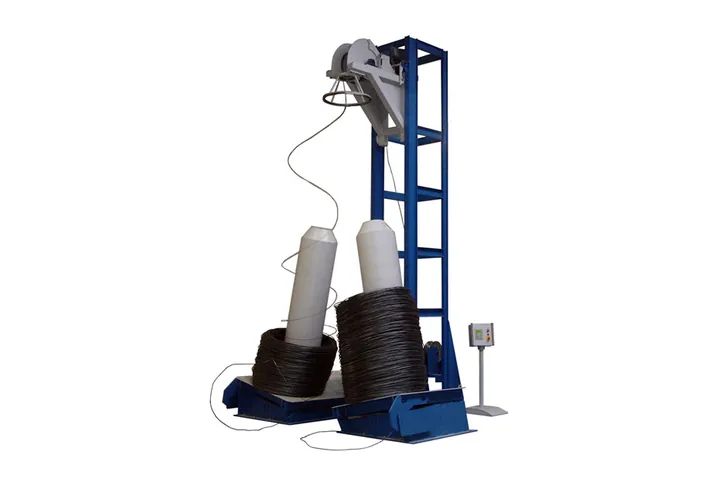
Rod should leave the coil without twisting and at steady tension. A tangle or a snatch at the payoff becomes a break at the first block. An overhead or rotating payoff that suits the coil weight, with room to change coils while the line runs, keeps the whole line steady.